When buying a second-hand car, most buyers focus on the engine, exterior, interior and tyres. However, one small but important component can create unexpected problems after purchase: the car battery.
A weak or ageing battery can cause starting difficulties, electrical issues and additional replacement expenses.
A car may look perfectly maintained, but if its battery is nearing the end of its useful life, you may need to replace it shortly after buying the vehicle.
If you are planning to purchase a used car in Dehradun, Haridwar, Rishikesh or anywhere in Uttarakhand, checking battery condition should be part of your pre-purchase inspection.
In this guide, CARSYZ explains how to check car battery health, identify common warning signs and understand why professional battery testing is important.
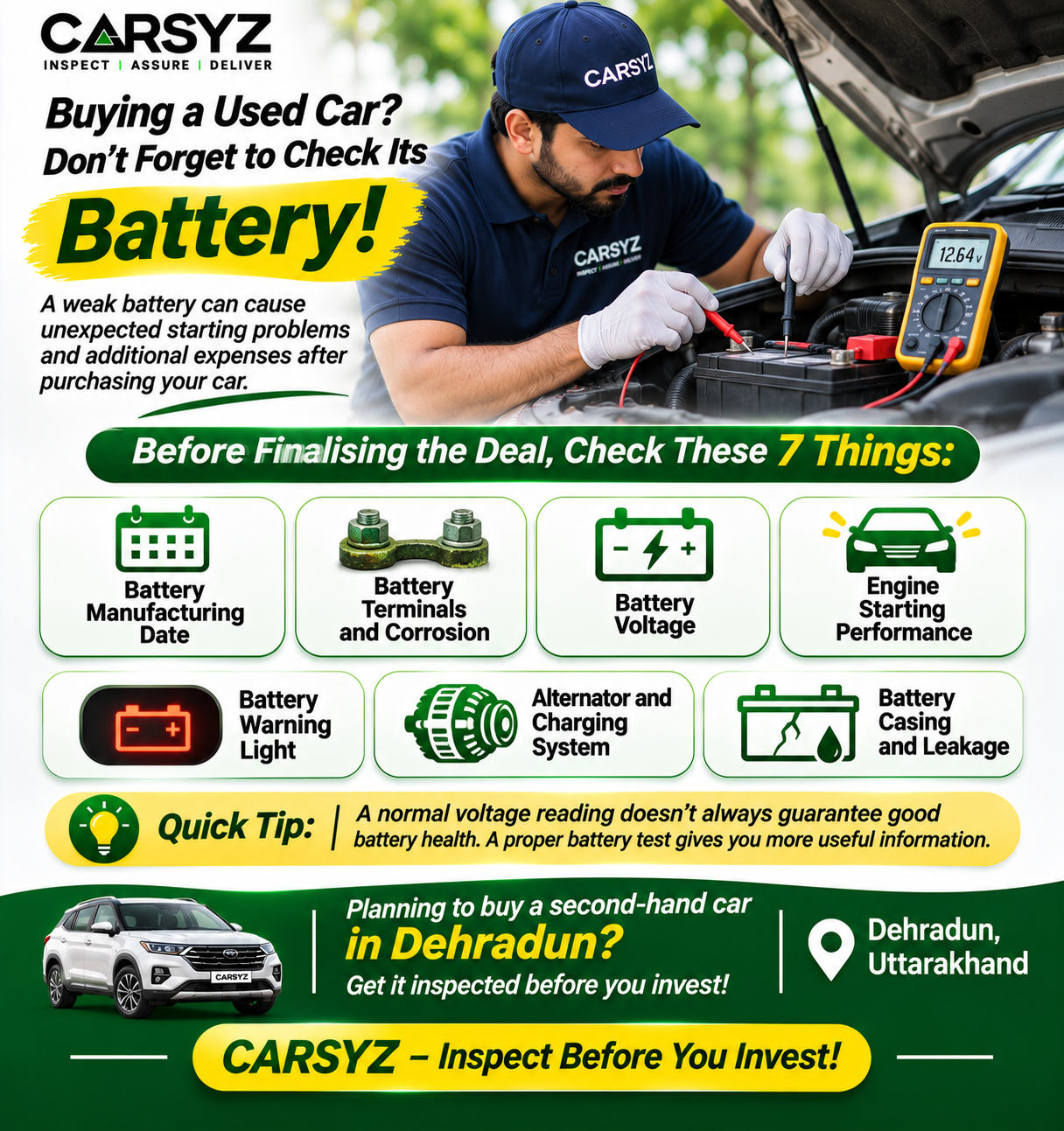
1. Check the Battery Manufacturing Date
One of the first things to check is the battery’s age.
Most automotive batteries have a manufacturing date or date code printed on their label or casing.
Look for:
- Manufacturing date.
- Battery model.
- Brand name.
- Capacity rating.
- Warranty information, if available.
Battery life varies depending on battery technology, vehicle usage, climate, maintenance and charging conditions.
An older battery is not automatically defective, and a newer battery is not automatically healthy. Actual battery performance should be tested.
2. Inspect Battery Terminals and Connections
Open the bonnet and visually inspect the battery terminals.
Check for:
- White or greenish corrosion around terminals.
- Loose battery connections.
- Damaged terminal clamps.
- Cracked battery casing.
- Signs of leakage.
- Damaged or poorly fitted cables.
Corrosion can affect electrical connections and may contribute to starting problems.
Never touch leaking battery fluid or attempt repairs without appropriate safety precautions. Battery inspection and cleaning should be handled properly.
3. Check Battery Voltage
A digital multimeter can help measure the battery’s voltage.
For a typical fully charged 12-volt lead-acid automotive battery, a resting voltage around 12.6 volts is commonly expected. Actual readings vary with battery type, temperature, charge state and measurement conditions.
As a general reference:
- Around 12.6V: Often indicates a well-charged conventional 12V battery.
- Around 12.4V: May indicate partial charge.
- Around 12.2V: Indicates a lower state of charge.
- Around 12.0V or below: Suggests significant discharge.
These are approximate reference values, not a complete battery health diagnosis.
A battery may show a reasonable resting voltage and still fail under load. A proper battery test is more informative than voltage alone.
4. Observe the Engine Starting Performance
Starting performance can provide useful clues about battery condition.
When you start the vehicle, observe whether:
- The engine starts smoothly.
- The starter motor turns unusually slowly.
- There is repeated clicking.
- Dashboard lights dim noticeably during starting.
- The vehicle needs repeated starting attempts.
These symptoms can be associated with a weak battery, but they can also result from starter motor, alternator, wiring or engine-related problems.
Do not assume every starting issue is caused by the battery.
5. Check the Battery Warning Light
Observe the dashboard warning lights before and after starting the engine.
The battery or charging-system warning light may illuminate briefly when the ignition is switched on.
After starting, it should generally switch off.
If it remains illuminated while the engine is running, the charging system may require attention.
Possible causes include:
- Alternator problems.
- Charging-system wiring issues.
- Battery-related faults.
- Belt or connection problems, depending on the vehicle.
A charging-system inspection may be needed to identify the actual cause.
6. Check the Alternator and Charging System
The battery stores electrical energy, while the alternator generally charges the battery when the engine is running in conventional petrol and diesel vehicles.
A problem with the charging system can cause repeated battery discharge.
A professional technician can check:
- Charging voltage.
- Alternator performance.
- Battery charging condition.
- Electrical connections.
- Relevant warning indicators.
Modern vehicles may use smart charging systems, so charging voltage can vary depending on operating conditions and vehicle design.
Do not judge alternator health using one voltage reading alone.
7. Look for Signs of Battery Leakage or Damage
A physically damaged battery should never be ignored.
Check for:
- Cracks in the battery casing.
- Bulging or swelling.
- Visible fluid leakage.
- Unusual smells.
- Damaged battery mounting.
- Loose or missing hold-down hardware.
A damaged or leaking battery can create safety concerns and should be assessed by a qualified professional.
Never attempt to open a sealed automotive battery.
8. Ask for Battery Replacement and Service Records
If the seller has replaced the battery recently, ask for supporting documents.
Useful records include:
- Battery purchase invoice.
- Warranty card or warranty details.
- Replacement date.
- Battery brand and model.
- Previous battery replacement history, if available.
These details help you understand whether the battery is original or has been replaced.
Also check whether the battery specifications are suitable for the vehicle.
9. Why Professional Battery Testing Matters
A visual inspection and voltage check can reveal some battery-related concerns, but they cannot establish complete battery health.
A professional battery test may assess:
- State of charge.
- Starting capability or measured cranking performance.
- Battery condition using a suitable tester.
- Charging-system performance.
- Electrical connection condition.
The exact tests depend on battery type, vehicle specifications and available equipment.
At CARSYZ, our goal is to help used-car buyers make informed decisions through vehicle inspection support.
If you are planning to buy a second-hand car in Dehradun, consider arranging a professional pre-purchase inspection before finalising the deal.
Frequently Asked Questions
1. How do I know if a used car battery is weak?
Common warning signs include slow engine cranking, repeated starting problems, battery warning indicators, corrosion and poor battery test results. A professional battery test can provide a better assessment.
2. What is the normal voltage of a car battery?
A typical fully charged 12V lead-acid battery may show around 12.6V at rest. Actual voltage varies depending on battery type, temperature and charge condition.
3. How long does a car battery last?
Battery life depends on battery technology, climate, driving patterns, maintenance and charging-system condition. There is no guaranteed lifespan for every vehicle.
4. Does a new battery guarantee good battery health?
No. A new battery can also be discharged, defective or unsuitable for the vehicle. It should be checked for correct specifications and performance.
5. Can a weak battery affect car starting?
Yes. A weak battery may not provide sufficient power to operate the starter motor properly, resulting in slow cranking or starting difficulties.
6. How can I check whether the alternator is working?
A qualified technician can test the charging system using suitable diagnostic equipment and check whether the alternator is charging the battery according to the vehicle’s specifications.
7. Should I replace a used car battery before buying the vehicle?
Not necessarily. First check its actual condition and obtain a professional test result. If replacement is required, consider the cost while negotiating the purchase price.
Final Thoughts
A car battery may be small, but it plays an important role in starting the vehicle and supporting its electrical systems.
Before buying a second-hand car, check the battery’s age, terminals, casing, starting performance and warning indicators. Where possible, get a proper battery and charging-system test.
A little inspection before purchase can help you avoid unexpected expenses and make a more confident decision.
CARSYZ – Inspect Before You Invest!
Planning to buy a used car in Dehradun or nearby areas? Contact CARSYZ to enquire about a professional pre-purchase vehicle inspection.