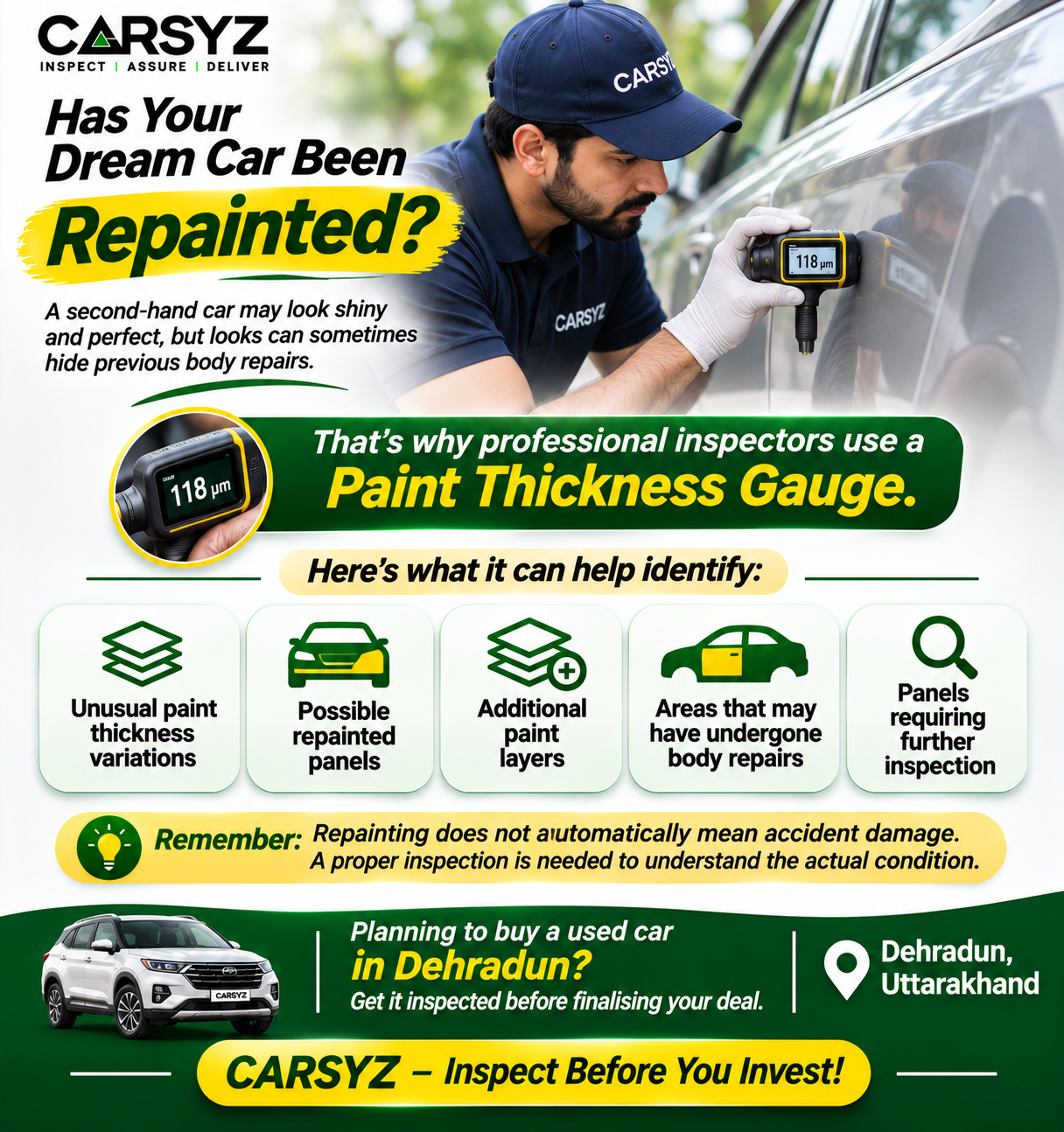
When buying a second-hand car, checking the exterior is not just about looking for scratches, dents or colour differences. It is also important to understand whether the vehicle has been repainted or undergone body repairs in the past.
Sometimes, a car looks perfectly maintained from the outside, but certain panels may have been repainted after scratches, dents or accidents.
This is where a paint thickness gauge becomes useful.
A paint thickness gauge is a specialised inspection tool that measures the thickness of the coating applied to a vehicle’s body panels. It can help identify differences in paint thickness and provide useful clues about previous repainting or bodywork.
If you are planning to purchase a used car in Dehradun, Haridwar, Rishikesh or anywhere in Uttarakhand, understanding this tool can help you make a more informed buying decision.
In this guide, CARSYZ explains what a paint thickness gauge is, how it works, what its readings mean and why it is useful during a professional used-car inspection.
1. What Is a Paint Thickness Gauge?
A paint thickness gauge is an electronic or mechanical measuring device used to measure the thickness of paint and other coatings on a vehicle’s body.
It is commonly used by automotive inspectors, car detailers and professionals involved in vehicle quality assessment.
The device measures the coating between its probe and the underlying material.
Measurements are commonly displayed in:
- Micrometres (µm)
- Mils
For example, a reading of 150 µm means the measured coating thickness is 150 micrometres.
The actual reading depends on several factors, including the vehicle manufacturer, paint system, body material and previous repair work.
2. How Does a Paint Thickness Gauge Work?
Most automotive paint thickness gauges use one of two measurement technologies.
A. Magnetic Induction
This technology is generally used on ferrous metal surfaces such as steel.
The device uses a magnetic field to measure the distance between its probe and the underlying metal surface.
B. Eddy Current Technology
This technology is commonly used on non-ferrous conductive metals such as aluminium.
It uses electromagnetic induction to measure coating thickness on compatible materials.
Some modern gauges support both technologies and automatically identify the surface material.
Important: Standard magnetic or eddy-current paint thickness gauges are generally not suitable for measuring paint on plastic panels. Specialised equipment is required for other material types.
3. Why Is Paint Thickness Measurement Important When Buying a Used Car?
A paint thickness gauge can help identify unusual variations in paint thickness across vehicle panels.
For example, if most panels have relatively consistent readings but one panel shows significantly different measurements, it may indicate previous repainting or bodywork.
This information can help buyers ask better questions about the vehicle’s history.
A paint thickness inspection may help identify:
- Possible repainting.
- Areas with additional paint layers.
- Differences between individual body panels.
- Possible filler or repair-related coating build-up.
- Panels that may need closer visual inspection.
However, a high reading does not automatically prove accident damage. Similarly, consistent readings do not guarantee that a vehicle has never been involved in an accident.
4. How Are Paint Thickness Readings Interpreted?
There is no single universal paint thickness reading that applies to every car.
Readings can vary depending on:
- Vehicle manufacturer.
- Factory paint process.
- Paint colour and coating system.
- Steel or aluminium body panels.
- Previous repainting.
- Surface preparation and repair quality.
For this reason, an inspector generally compares multiple readings across different panels rather than judging a vehicle using one measurement.
A useful inspection approach is to take several readings from different locations on compatible panels and look for unusual variations.
The readings should always be interpreted alongside visual inspection and other available evidence.
5. How Can a Paint Thickness Gauge Help Identify Repainted Panels?
Suppose you are inspecting a second-hand car.
You take readings from the bonnet, front doors, rear doors, boot and other compatible metal panels.
Most panels show broadly similar readings, but one door shows noticeably higher measurements.
This may suggest:
- The panel has been repainted.
- Additional paint layers have been applied.
- Body filler or repair material may be present.
- The panel has undergone previous repair work.
The next step is to examine that panel carefully for:
- Overspray around rubber seals.
- Paint differences under suitable lighting.
- Uneven panel gaps.
- Visible repair marks.
- Differences in surface texture.
- Signs of replacement or previous bodywork.
A paint thickness reading is an indicator that helps guide further inspection, not a final verdict.
6. Does Repainting Always Mean the Car Has Had an Accident?
No.
A repainted panel does not necessarily mean the car has been involved in a major accident.
Repainting may happen because of:
- Minor scratches.
- Parking dents.
- Cosmetic damage.
- Scratches caused by other vehicles.
- Faded paint.
- Local bodywork repairs.
The important thing is to understand why the panel was repainted and whether the repair involved any structural components.
If there are signs of structural damage, the vehicle should be assessed by a qualified professional.
7. Can a Paint Thickness Gauge Detect Accident-Damaged Cars?
A paint thickness gauge can provide useful information about paint and coating variations, but it cannot independently confirm whether a vehicle has been in an accident.
A vehicle may have experienced structural damage without obvious paint thickness differences.
Likewise, a panel may show increased paint thickness due to a purely cosmetic repair.
A comprehensive accident assessment may also require checking:
- Chassis and structural components.
- Pillars and roof areas.
- Inner body panels.
- Bonnet and boot alignment.
- Welds and visible joining points.
- Airbag and restraint-system indicators, where applicable.
The final assessment should consider all available evidence rather than relying on one inspection tool.
8. Why Professional Paint Inspection Is Better Than Guesswork
Many buyers try to identify repainting by comparing paint colours or looking for visible scratches.
However, professional inspection tools can reveal coating variations that may not be easy to notice with the naked eye.
A professional vehicle inspection can combine paint thickness measurements on compatible surfaces with visual examination of body panels and other relevant vehicle areas.
At CARSYZ, our aim is to help buyers understand the condition of a vehicle before making a purchase decision.
If you are planning to buy a second-hand car in Dehradun, consider arranging a professional pre-purchase inspection.
Frequently Asked Questions
1. What is a normal car paint thickness reading?
There is no universal normal reading for every vehicle. Factory paint thickness varies by manufacturer, model, panel and paint system. Readings should be compared across suitable panels of the same vehicle.
2. Can a paint thickness gauge detect repainting?
It can help identify unusual coating thickness variations that may indicate repainting or previous bodywork. However, the reading should be verified through visual inspection and other evidence.
3. Does high paint thickness mean an accidental car?
No. High readings may indicate additional paint layers, filler or previous repairs. They do not automatically prove accident damage.
4. Can a paint thickness gauge check plastic bumpers?
Most conventional magnetic and eddy-current gauges are designed for compatible metal surfaces. They generally cannot measure plastic bumpers using standard measurement methods.
5. Can a paint thickness gauge identify original paint?
It can help assess paint consistency and identify unusual variations. However, it cannot independently certify that every panel has factory-original paint.
6. Is paint thickness inspection important before buying a used car?
Yes. It is a useful part of a broader pre-purchase inspection because it can help identify panels that may have undergone repainting or bodywork.
7. Should I reject a used car if one panel is repainted?
Not necessarily. Understand the reason for repainting, check the quality of the repair and investigate whether any structural damage is present before making your decision.
Final Thoughts
A paint thickness gauge is a valuable tool for used-car inspection. It helps identify variations in coating thickness and highlights panels that may require further examination.
However, no single measurement can tell the complete history of a vehicle.
Before purchasing a second-hand car, combine paint thickness readings with a thorough visual and mechanical inspection.
CARSYZ – Inspect Before You Invest!
Planning to buy a used car in Dehradun or nearby areas? Contact CARSYZ to enquire about a professional vehicle inspection and make a more informed buying decision.