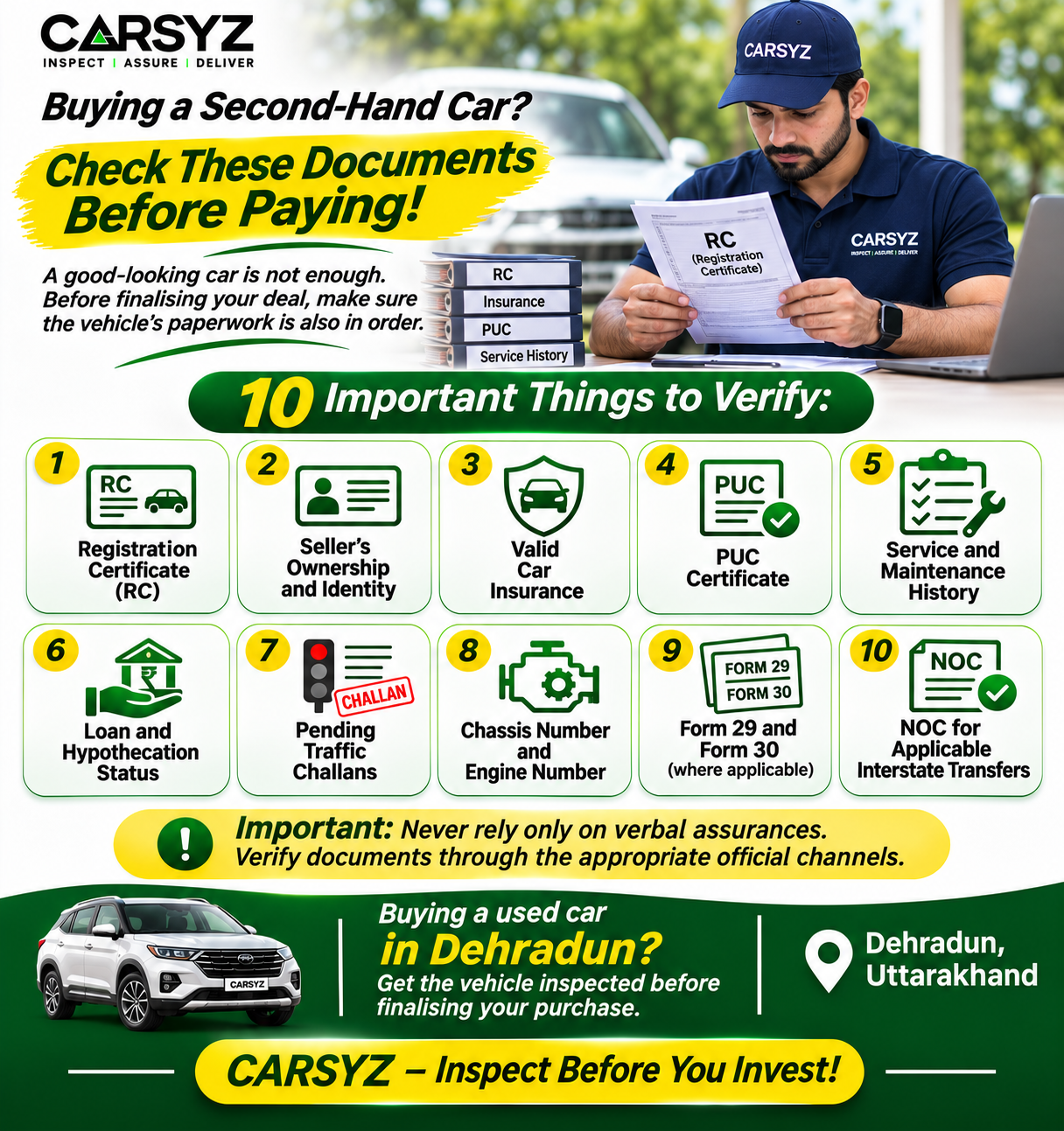
Buying a second-hand car can be a great way to save money, but checking the vehicle’s condition is only one part of the buying process. Equally important is verifying its documents before making the payment.
A car may look perfect, have a good engine and offer an attractive price, but incomplete paperwork, pending loans, ownership issues or invalid insurance can create serious complications later.
Whether you are planning to buy a used car in Dehradun, Haridwar, Rishikesh or anywhere in Uttarakhand, verifying the documents is essential before completing the purchase.
In this guide, CARSYZ explains the important documents to check before buying a second-hand car in India.
1. Registration Certificate (RC)
The Registration Certificate, commonly called RC, is one of the most important documents of a vehicle.
It contains important details about the registered vehicle and its ownership.
Check the following details:
- Registered owner’s name.
- Registration number.
- Chassis number.
- Engine number.
- Vehicle make and model.
- Fuel type.
- Registration date.
- Registration validity, where applicable.
- Hypothecation details, if any.
Compare the RC information with the actual vehicle.
Pay special attention to the chassis number and engine number. Any mismatch should be clarified and verified before proceeding.
You can also use the official VAHAN portal or authorised government services to check available vehicle registration information.
2. Verify the Seller’s Ownership
Before buying a used car, confirm that the person selling the vehicle is authorised to sell it.
Check:
- Whether the seller’s identity matches the registered owner.
- Whether the seller has the necessary authority if acting on behalf of the owner.
- Whether the vehicle has multiple ownership or transfer-related issues.
- Whether the ownership information matches available official records.
If the seller is not the registered owner, ask for appropriate authorisation and supporting documents.
Avoid transferring money to an unrelated person without verifying their authority to complete the sale.
3. Check Car Insurance Policy
Valid motor insurance is another important document to verify.
Ask the seller for the current insurance policy and check:
- Policy number.
- Insurance company.
- Vehicle registration number.
- Policy validity dates.
- Type of coverage.
- Insured vehicle details.
- Available claim or policy history, where accessible.
Check whether the policy is third-party or comprehensive.
Also remember that insurance ownership details and policy transfer formalities should be completed as applicable after the sale.
Do not assume that the seller’s insurance automatically transfers to you without completing the required process.
4. Check the Pollution Under Control (PUC) Certificate
A valid Pollution Under Control certificate is an important compliance document for applicable vehicles.
Check:
- Certificate validity.
- Vehicle registration number.
- Emission test details.
- Certificate information.
A valid PUC certificate helps establish that the vehicle has undergone the required emissions testing within the applicable validity period.
You can verify available certificate information through authorised government services.
5. Check Service History and Maintenance Records
Service history helps you understand how the vehicle has been maintained.
Ask the seller for available:
- Authorised service centre records.
- Service invoices.
- Engine oil change records.
- Major repair invoices.
- Battery replacement records.
- Tyre replacement details.
- Accident or insurance repair records, if available.
Compare the service history with the odometer reading and vehicle age.
Missing service records do not automatically mean that the car has been poorly maintained, but they make its maintenance history harder to verify.
6. Check Loan and Hypothecation Status
This is one of the most important checks before purchasing a second-hand car.
If the vehicle was purchased through a loan, its RC may show hypothecation in favour of a bank or financial institution.
Before proceeding:
- Check whether hypothecation is mentioned in the RC.
- Ask the seller whether the loan has been fully repaid.
- Request the lender’s loan closure or no-dues documentation, where applicable.
- Verify whether the hypothecation termination process has been completed.
- Confirm the correct transfer procedure with the concerned RTO.
If the loan is still active, do not assume that a verbal assurance from the seller is sufficient.
The outstanding loan and release process should be properly settled and documented before ownership transfer is completed.
7. Check the Vehicle’s Challan History
Before buying a used car, check whether any pending traffic challans are associated with the vehicle.
You can use the official e-Challan portal to check available challan information.
Verify:
- Pending challans.
- Payment status.
- Vehicle registration details.
- Any unresolved notices, where available.
Clarify responsibility for pending challans with the seller before completing the transaction.
8. Verify Chassis Number and Engine Number
The chassis number, also known as the Vehicle Identification Number (VIN), is an important vehicle identifier.
Compare the number mentioned in the RC with the number physically marked on the vehicle.
Also verify the engine number where it is recorded and accessible.
Look for:
- Matching identification details.
- Clear and readable markings.
- Signs of alteration or tampering.
- Differences between physical markings and documents.
If you notice any mismatch or suspicious alteration, stop the transaction and seek verification from the appropriate authority.
9. Check Form 29 and Form 30 for Ownership Transfer
For a used-car ownership transfer in India, the applicable registration transfer process generally involves prescribed forms and supporting documentation.
Form 29 is used for notice of transfer of ownership, while Form 30 is used for an application for transfer of ownership.
Depending on the circumstances, additional documents, declarations or procedures may be required.
Before signing or submitting anything:
- Verify the seller and buyer details.
- Check vehicle registration information.
- Confirm the required signatures.
- Understand the applicable RTO process.
- Keep copies of submitted documents and acknowledgements.
Requirements and processes can vary depending on the transaction and applicable rules. Check the current requirements with the concerned RTO or official Parivahan services.
10. Check NOC for Vehicles Registered in Another State
If you are purchasing a vehicle registered in another state, additional documentation may be required.
A No Objection Certificate (NOC) may be necessary for certain interstate transfer and re-registration situations.
Before buying an out-of-state vehicle, check:
- Existing registration details.
- Applicable NOC requirements.
- Tax-related requirements.
- Re-registration procedure, where applicable.
- Supporting documents required by the destination RTO.
If you are buying a vehicle in Dehradun that is registered outside Uttarakhand, confirm the applicable process with the relevant transport authority before making payment.
11. Keep a Copy of the Sale Agreement and Payment Proof
Apart from the vehicle documents, maintain proper transaction records.
Important records may include:
- Signed sale agreement or delivery documentation.
- Seller and buyer identification details.
- Payment receipt or bank transfer proof.
- Vehicle handover date and time.
- Odometer reading at handover.
- Copies of relevant transfer documents.
- Keys and accessories handed over.
These records help establish the details of the transaction and reduce misunderstandings between the buyer and seller.
12. Complete Ownership Transfer After Purchase
Checking documents is not enough. The ownership transfer process must also be completed through the applicable official procedure.
After purchasing the vehicle:
- Submit the required transfer application.
- Complete the applicable RTO formalities.
- Track the transfer application.
- Ensure the RC ownership details are updated.
- Complete applicable insurance transfer formalities.
- Retain acknowledgements and supporting documents.
Do not rely only on a signed sale agreement as proof that the official RC transfer has been completed.
Complete Used Car Documents Checklist
Before finalising your purchase, review this checklist:
- Original or valid digital Registration Certificate.
- Seller identity and ownership verification.
- Valid motor insurance policy.
- Valid PUC certificate, where applicable.
- Available service and maintenance records.
- Loan closure and hypothecation documents, if applicable.
- Pending challan verification.
- Chassis number and engine number verification.
- Required ownership transfer forms.
- NOC and related documents for applicable interstate transactions.
- Sale agreement and payment proof.
- Vehicle handover records.
Why Professional Used Car Inspection Matters
Documents help establish the vehicle’s registration and ownership information, but they do not reveal its complete mechanical or physical condition.
A vehicle may have valid documents and still have hidden engine, suspension, paint or accident-related concerns.
That is why document verification should be combined with a physical and mechanical inspection.
CARSYZ aims to help used-car buyers make more informed decisions through professional vehicle inspection support.
If you are planning to buy a second-hand car in Dehradun or nearby areas, consider getting the vehicle inspected before finalising your deal.
Frequently Asked Questions
1. What documents should I check before buying a second-hand car in India?
Check the RC, insurance policy, PUC certificate, service history, loan and hypothecation status, challan history, chassis and engine numbers, and ownership transfer documents.
2. Is the original RC compulsory when buying a used car?
The vehicle’s registration details must be properly verified. An authorised digital RC may also be available through recognised government platforms. Confirm the applicable requirements with the RTO.
3. How can I check whether a used car has an active loan?
Check the hypothecation details on the RC and verify the loan status with the concerned bank or financial institution. Obtain the required loan closure and hypothecation termination documentation.
4. What are Form 29 and Form 30?
Form 29 is used for notice of transfer of ownership, while Form 30 is used for an application for transfer of ownership under the applicable vehicle registration process.
5. How can I check pending challans on a used car?
Use the official e-Challan portal to check available vehicle challan information and payment status.
6. Is a PUC certificate required for a used car?
Applicable vehicles must comply with the relevant pollution certification requirements. Check the certificate’s validity and applicable rules before purchase.
7. Should I buy a used car without proper documents?
It is advisable not to proceed until ownership, registration, loan status and other required documentation have been properly verified.
Final Thoughts
Buying a second-hand car is not just about finding the right model at the right price. Proper document verification is equally important.
Before making payment, check the RC, insurance, PUC, service history, loan status, challans and ownership transfer requirements.
Combine document verification with a professional vehicle inspection to make a more informed buying decision.
CARSYZ – Inspect Before You Invest!
Planning to buy a used car in Dehradun or nearby areas? Contact CARSYZ to enquire about a professional pre-purchase vehicle inspection.