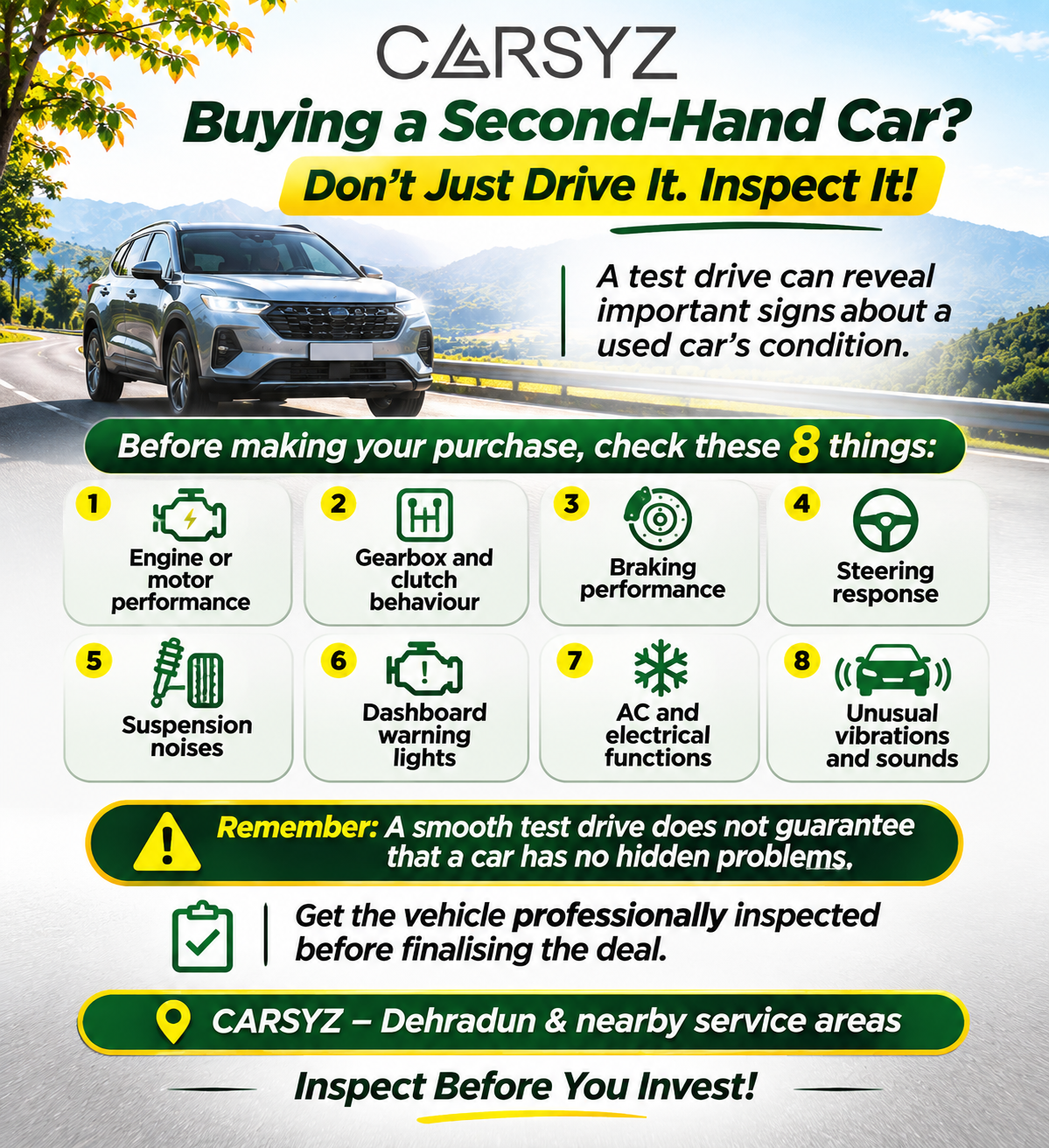
Buying a second-hand car is a major decision. A vehicle may look attractive in photographs, have a clean interior and appear well-maintained, but its actual driving condition can only be understood through a careful inspection and test drive.
A test drive is not just about checking whether the car starts, accelerates and moves smoothly. It is an opportunity to observe the engine or motor, transmission, brakes, steering, suspension, tyres and dashboard indicators under normal driving conditions.
If you are planning to buy a used car in Dehradun or nearby areas of Uttarakhand, this guide will help you understand what to check during a test drive before making your purchase decision.
1. Start the Car and Observe the Engine
For petrol and diesel cars, start the engine when it is reasonably cool, if practical and safe.
Observe:
- Whether the engine starts smoothly.
- Whether there are unusual knocking or rattling sounds.
- Whether the engine idles steadily.
- Whether there is excessive vibration.
- Whether any warning lights remain illuminated.
- Whether visible smoke comes from the exhaust.
A cold start can sometimes reveal issues that may not be noticeable after the engine warms up.
However, one observation alone does not confirm a mechanical fault. Unusual sounds, smoke or vibrations should be assessed by a qualified technician.
For electric vehicles, check the vehicle’s ready status, dashboard warnings, motor noise and overall operating behaviour instead of looking for a conventional engine start.
2. Check Acceleration and Pickup
During the test drive, accelerate gradually on a suitable and safe road.
Observe:
- Whether acceleration is smooth.
- Whether the engine responds consistently.
- Whether there is hesitation or jerking.
- Whether the vehicle struggles unexpectedly.
- Whether unusual vibrations occur during acceleration.
For turbocharged cars, pay attention to inconsistent power delivery or unusual noises. Any suspected problem should be checked professionally rather than diagnosed only through a short drive.
For EVs, observe acceleration response and any warning messages related to the motor or battery system.
3. Inspect the Gearbox and Transmission
Transmission behaviour is an important part of a used-car test drive.
For manual cars, check:
- Smooth gear engagement.
- Clutch pedal feel.
- Unusual vibration while releasing the clutch.
- Difficulty selecting gears.
- Unusual noises during gear changes.
For automatic cars, check:
- Smooth engagement when selecting Drive or Reverse.
- Delayed engagement.
- Jerks during acceleration.
- Unusual noises or vibrations.
- Warning messages related to the transmission.
Different automatic transmissions, including AMT, CVT, DCT and torque-converter systems, can feel different. Compare their behaviour with the manufacturer’s expected operation for that model.
Do not deliberately perform aggressive acceleration or harsh driving to test the transmission.
4. Check the Braking System
Brakes are among the most important safety components of a vehicle.
During a test drive, observe:
- Whether the brake pedal feels consistent.
- Whether the vehicle slows down smoothly.
- Whether there is unusual vibration during braking.
- Whether the vehicle pulls to one side.
- Whether there are grinding or squealing sounds.
- Whether any brake-related warning lights appear.
Only test the brakes in a safe, legal and suitable area. Avoid sudden or emergency braking tests on public roads.
If you notice abnormal braking behaviour, do not ignore it. Have the braking system professionally checked before purchase.
5. Test Steering Response
The steering should respond predictably during normal driving.
Check:
- Whether the steering feels unusually heavy.
- Whether there is excessive free play.
- Whether the vehicle pulls to one side on a suitable level road.
- Whether there are unusual sounds while turning.
- Whether the steering wheel vibrates unexpectedly.
Some steering systems naturally feel lighter or heavier depending on the vehicle. Compare the behaviour with the manufacturer’s specifications and have unusual symptoms investigated.
6. Check Suspension on Uneven Roads
Suspension condition can affect comfort, handling and safety.
During a normal test drive, observe the vehicle while driving over suitable road imperfections at an appropriate speed.
Look for:
- Repeated bouncing after a bump.
- Knocking or clunking sounds.
- Excessive body movement.
- Unusual vibration.
- Poor stability.
- Uneven tyre wear that may indicate a related issue.
Dehradun roads can include speed breakers, uneven surfaces and changing road conditions. A careful drive on a suitable route can help you observe how the vehicle behaves.
Never drive aggressively over potholes or speed breakers to test suspension.
7. Check for Unusual Vibrations
Vibration can originate from different vehicle components.
Pay attention to:
- Steering wheel vibration.
- Vibration through the seat.
- Vibration during acceleration.
- Vibration while braking.
- Unusual vibration at normal driving speeds.
Possible causes can include wheel balancing, tyre condition, suspension components, engine mounts or drivetrain issues.
A test drive can reveal symptoms, but a technician should identify the actual cause.
8. Observe the Dashboard Warning Lights
The dashboard provides important information about the vehicle.
Before starting, observe the warning-light self-check process as described in the owner’s manual. After the vehicle is started or made ready, check whether any warning indicators remain illuminated.
Pay attention to:
- Check-engine warning.
- ABS warning.
- Airbag warning.
- Battery or charging-system warning.
- Engine temperature warning.
- Oil pressure warning.
- Transmission warning.
- EV battery or motor warnings, where applicable.
Some warning lights may illuminate briefly during the normal startup check. The concern is an indicator that remains on or appears while driving unexpectedly.
A diagnostic scan may provide additional information, but its coverage depends on the vehicle and diagnostic equipment. A clean scan does not guarantee that the vehicle is fault-free.
9. Check the Air Conditioning System
Air conditioning is particularly important for everyday comfort.
During the drive, check:
- Cooling performance.
- Blower speed at different settings.
- Airflow from the vents.
- Temperature adjustment.
- Unusual noises.
- Unpleasant smells.
- AC operation at idle and during normal driving.
For climate-control systems, test the available settings and compare their operation with the vehicle’s specifications.
10. Listen for Unusual Noises
Turn off the music during the test drive so that you can hear the vehicle clearly.
Listen for:
- Engine knocking or rattling.
- Suspension clunks.
- Wheel-bearing humming.
- Brake squealing or grinding.
- Gearbox noises.
- Unusual motor sounds in EVs.
- Interior rattles.
A noise may have several possible causes. Do not assume that every sound indicates a major problem, but make sure unexplained noises are investigated before buying.
11. Check the Clutch in a Manual Car
For a manual transmission vehicle, pay attention to the clutch during normal operation.
Observe:
- Clutch pedal feel.
- Smoothness when moving from a standstill.
- Gear engagement.
- Unusual vibration.
- Slipping symptoms under normal driving conditions.
A clutch that slips or behaves abnormally may require repair. Do not perform risky high-load tests on public roads to confirm clutch condition.
12. Check Reverse Gear and Parking Manoeuvres
In a safe and open area, test normal parking manoeuvres.
Check:
- Reverse gear engagement.
- Reverse camera, if equipped.
- Parking sensors, if equipped.
- Steering response at low speed.
- Visibility and mirror adjustment.
- Parking brake operation.
Make sure the surroundings are clear before reversing.
13. Check the Vehicle After the Test Drive
Once the test drive is complete, park the car safely and observe it again.
Check:
- Whether any warning lights have appeared.
- Whether there are unusual smells.
- Whether there is visible fluid leakage.
- Whether the engine or motor sounds normal.
- Whether the temperature indicators are within the expected range.
- Whether any new noise or vibration is noticeable.
For petrol and diesel vehicles, avoid opening a hot radiator cap or touching hot engine components. Ask a qualified technician to inspect anything unusual.
14. Never Rely on a Test Drive Alone
A test drive is an important part of used-car evaluation, but it cannot reveal every hidden issue.
Some problems may require additional inspection, diagnostic equipment or a detailed workshop assessment.
Before purchasing, also consider:
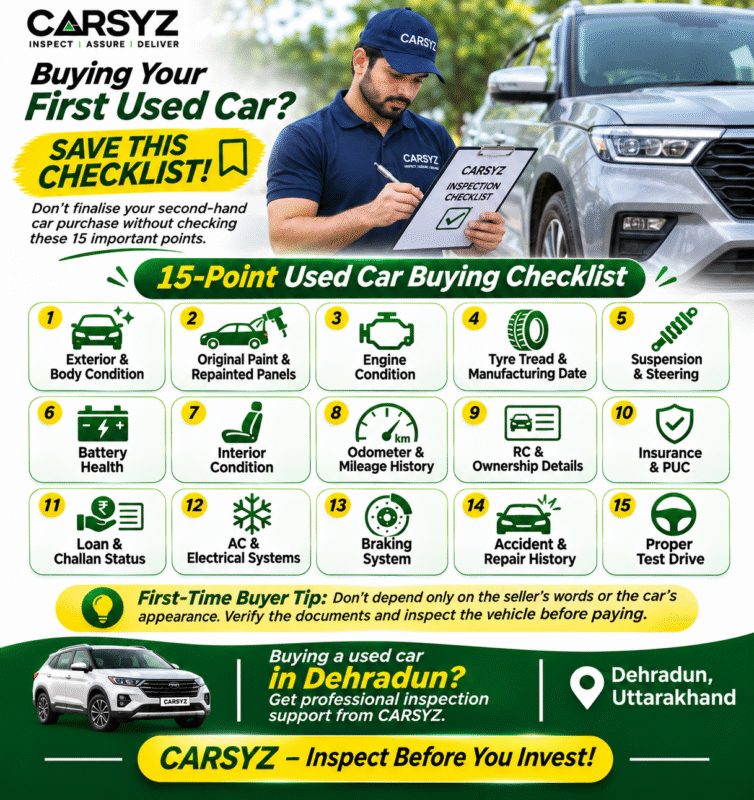
- Accident and structural damage assessment.
- Paint and panel inspection.
- Engine or motor condition.
- Transmission assessment.
- Suspension and steering inspection.
- Tyre and brake condition.
- Electrical and electronic systems.
- Service history.
- RC, insurance and ownership verification.
- Available diagnostic reports.
A complete inspection gives you a broader understanding of the vehicle than a short road test alone.
15. Used Car Test Drive Checklist
Use this quick checklist before making your decision:
- Engine or motor starts and operates normally.
- No unexplained warning indicators.
- Smooth acceleration.
- Transmission operates as expected.
- Brakes respond consistently.
- Steering feels predictable.
- No unusual suspension noises.
- No unexpected vibration.
- Air conditioning works properly.
- No unexplained engine, gearbox or motor noises.
- Reverse gear and parking functions work.
- No obvious fluid leakage after the drive.
- Dashboard and electrical features operate correctly.
- Vehicle documents and service history are available.
- Any suspicious symptoms are professionally checked.
Why Choose CARSYZ for Used Car Inspection in Dehradun?
A test drive gives you a feel for the vehicle, but a structured inspection helps you evaluate more areas before making a purchase.
CARSYZ offers used-car inspection services in Dehradun and nearby service areas to help buyers assess the condition of a vehicle before making a decision.
Depending on the vehicle and agreed inspection scope, checks may cover exterior and interior condition, paint and panel observations, tyres, visible mechanical components and other relevant areas.
Contact CARSYZ to discuss your vehicle, confirm service availability and understand the inspection coverage before booking.
CARSYZ – Inspect Before You Invest!
Frequently Asked Questions
1. How long should a used car test drive be?
There is no fixed duration for every vehicle. Allow enough time to observe the car during normal driving, acceleration, braking, steering and parking manoeuvres on suitable roads.
2. What should I check first during a used car test drive?
Start by observing the startup behaviour and dashboard indicators. Then check acceleration, transmission, braking, steering, suspension and unusual sounds.
3. Should I test drive a used car before buying it?
Yes. A test drive helps you understand the vehicle’s driving behaviour and identify symptoms that may require further inspection.
4. Can a test drive identify engine problems?
A test drive may reveal symptoms such as unusual sounds, vibration, hesitation or warning lights. However, it cannot identify every engine problem. Further mechanical inspection may be required.
5. What should I check in an automatic car?
Check smooth gear engagement, acceleration response, unusual jerks, transmission warnings and any unexplained noises. Behaviour should be assessed according to the specific transmission type.
6. Should I get a used car professionally inspected after a test drive?
Yes. A professional inspection can assess areas that may not be fully evaluated during a short test drive, including visible damage, mechanical condition, tyres, suspension and available diagnostic information.
7. Where can I get a used car inspected in Dehradun?
You can contact CARSYZ to enquire about used-car inspection services in Dehradun and nearby areas. Confirm the inspection scope and appointment availability before booking.
Conclusion
A used car may look good, but its real condition matters more than its appearance.
Take a careful test drive, observe how the vehicle behaves and never ignore unusual sounds, vibrations or warning indicators.
Most importantly, do not make the final purchase decision based only on a test drive. Combine it with document verification and a suitable professional inspection.
Planning to buy a second-hand car in Dehradun?
Get it inspected before you invest.
CARSYZ – Inspect Before You Invest!