Buying a second-hand electric car can be a smart way to experience electric mobility at a lower purchase price. However, buying a used EV requires a different inspection approach compared with buying a petrol or diesel car.
In a conventional car, buyers usually focus on the engine, gearbox, clutch, suspension and overall mechanical condition. In an electric vehicle, the battery pack, battery management system, charging equipment, high-voltage components and battery warranty become especially important.
If you are planning to buy a used electric car in Dehradun or anywhere in Uttarakhand, do not make your decision only on the basis of the car’s appearance, advertised driving range or asking price. A proper inspection can help you understand the vehicle’s condition and identify questions that need clarification before completing the purchase.
Let’s understand what you should check before buying a second-hand electric car.
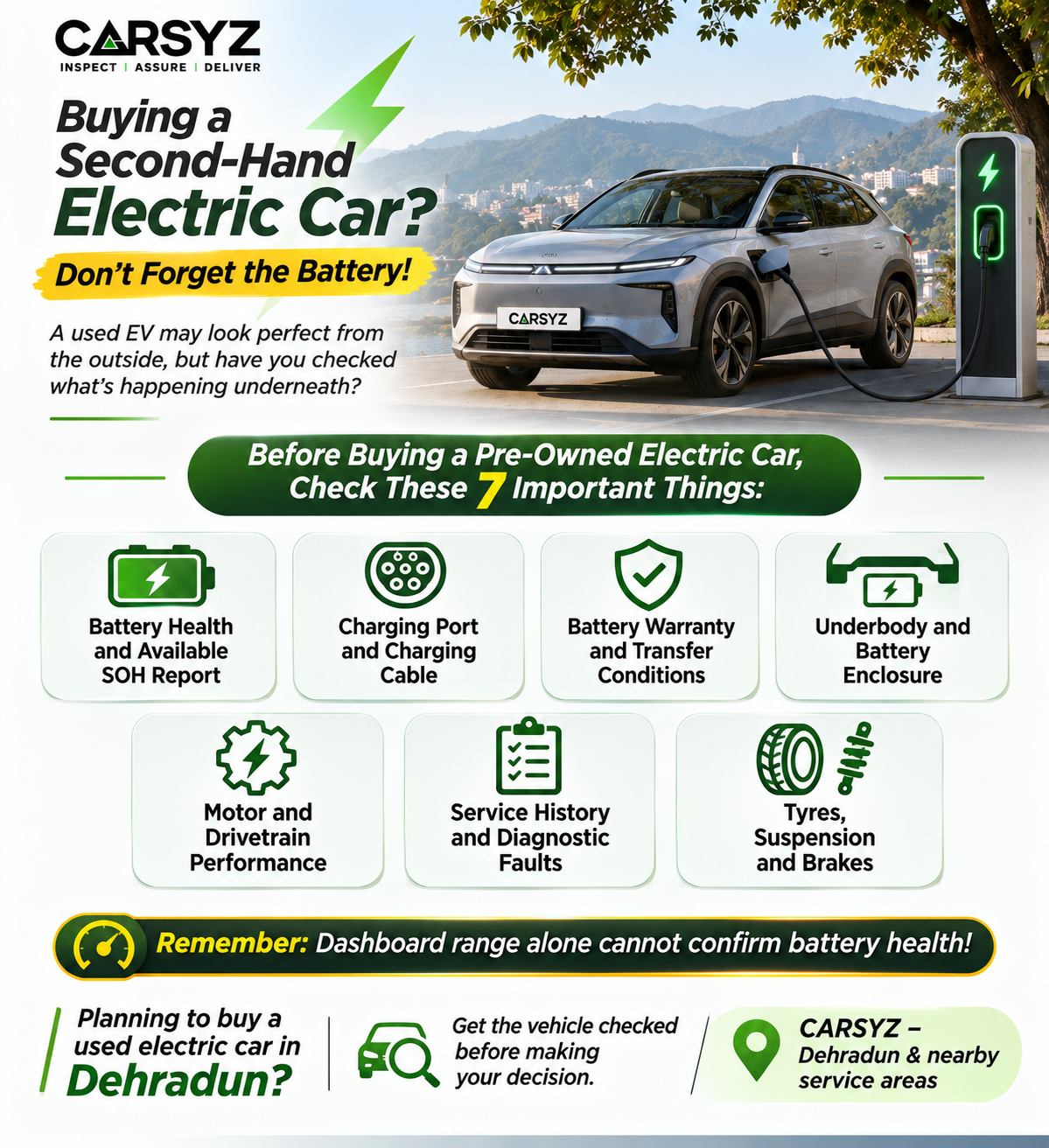
1. Check the EV Battery Health
The battery is one of the most important components of an electric car. Its condition can influence the vehicle’s usable driving range, charging behaviour and long-term ownership experience.
Ask the seller for a battery health or State of Health (SOH) report, if available.
SOH is an indicator of the battery’s condition compared with its original capacity. However, the way it is calculated and reported can vary between manufacturers.
Before relying on a battery report, check:
- Whether the report is generated using a manufacturer-approved or compatible diagnostic method.
- The date on which the battery assessment was performed.
- Whether the report shows battery capacity or other relevant health information.
- Whether any battery-related warning messages are present.
- Whether the manufacturer can confirm the reported battery status.
Important: There is no single universal SOH percentage that guarantees a used EV is good or bad. Interpret the result according to the vehicle model, age, mileage and manufacturer’s guidance.
2. Do Not Judge Battery Health Only by Driving Range
The displayed range on an electric car’s dashboard is an estimate, not a direct measurement of battery health.
It can change depending on:
- Driving style and speed.
- Outside temperature.
- Use of air conditioning or heating.
- Road conditions and elevation.
- Previous driving patterns.
- Battery charge level and vehicle settings.
For example, a car showing a lower estimated range does not automatically mean that its battery is damaged.
Ask for the manufacturer’s claimed range for that particular variant and compare it with the vehicle’s available battery information and actual usage history. A controlled test drive can provide additional context, but it cannot independently confirm battery health.
3. Verify Battery Warranty Details
Battery warranty can be an important part of a used EV purchase.
Do not assume that the battery warranty is automatically transferable or that it covers every type of battery-related issue.
Ask the seller to provide:
- Original purchase invoice.
- Warranty booklet or official warranty terms.
- Vehicle identification number (VIN).
- Battery warranty start date.
- Applicable kilometre limit.
- Warranty exclusions and conditions.
- Confirmation of transferability from the manufacturer or authorised dealer.
Contact the manufacturer’s authorised service network to verify the warranty status using the vehicle details.
A written confirmation is preferable to relying only on the seller’s verbal assurance.
4. Inspect the Charging Port and Charging Equipment
Charging equipment should be checked before buying a used electric car.
Look for visible damage, cracks, corrosion, loose-fitting components or signs of overheating around the charging port.
Also check:
- Whether the charging port cover closes properly.
- Whether the supplied charging cable is original or manufacturer-approved.
- Whether the connector has visible damage.
- Whether the vehicle recognises the charging connection.
- Whether charging-related warning messages appear.
Where compatible equipment and a safe charging facility are available, arrange a charging test. Check the charging process according to the manufacturer’s instructions.
If the car supports different charging types, verify the relevant AC and DC charging functions where applicable.
Never attempt to open or repair high-voltage charging components yourself.
5. Check the Battery Pack and Underbody
The battery pack is generally positioned underneath the vehicle, making underbody inspection especially important.
Ask a qualified EV technician to inspect the accessible underbody and battery enclosure for:
- Visible dents or deformation.
- Signs of impact damage.
- Scratches or damaged protective covers.
- Corrosion or unusual leakage around relevant components.
- Evidence of previous repairs.
- Any battery-related warning messages.
A damaged battery enclosure should not be ignored, even if the vehicle appears to drive normally.
Safety warning: High-voltage battery packs and their electrical connections should only be inspected by trained technicians using appropriate safety procedures. Do not touch or remove high-voltage components.
6. Check the Battery Cooling System
Some electric vehicles use dedicated battery thermal-management systems to maintain suitable operating temperatures.
Depending on the model, the system may involve liquid cooling, air cooling or another manufacturer-specific arrangement.
Ask the technician to check:
- Relevant cooling-system warning messages.
- Visible signs of leakage, where applicable.
- Cooling-system service history.
- Whether any battery-temperature-related faults are recorded.
- Whether the system has been repaired previously.
Not every EV uses the same cooling arrangement, so the inspection should follow the manufacturer’s specifications.
7. Review the Service and Repair History
A used EV should have a traceable maintenance and repair history.
Request available service records from the seller and verify important details with an authorised service centre where possible.
Pay attention to:
- Battery-related repairs.
- Charging-system repairs.
- Software updates.
- Motor or inverter-related work.
- High-voltage system warnings.
- Accident or underbody damage repairs.
- Manufacturer recalls and completed recall work.
A diagnostic scan may help identify certain stored fault codes, but its coverage depends on the vehicle, software and diagnostic equipment. A clean scan does not guarantee that the car has no issues.
8. Check the Electric Motor and Driving Performance
Electric cars do not have conventional petrol or diesel engines, but their motors and related systems still need inspection.
During a test drive, observe:
- Smooth acceleration.
- Unusual vibration or noise.
- Warning messages on the dashboard.
- Regenerative braking behaviour.
- Smooth transitions between acceleration and deceleration.
- Any unusual motor or drivetrain sounds.
If you notice unexpected behaviour, ask a qualified technician to investigate it before finalising the purchase.
9. Inspect the Suspension, Tyres and Brakes
Electric vehicles can be heavier than comparable petrol or diesel cars because of their battery packs. Tyres, suspension and braking components therefore deserve proper attention.
Check:
- Tyre tread depth and uneven wear.
- Tyre sidewalls for cuts or bulges.
- Suspension noise over uneven roads.
- Steering response.
- Brake condition.
- Brake warning indicators.
- Parking brake operation.
Regenerative braking can affect how frequently conventional friction brakes are used. However, this does not mean that brake inspection can be skipped.
10. Check the Interior, Electronics and Software
Modern electric cars often have multiple electronic features and connected systems.
Test the features available in the particular model:
- Instrument cluster and touchscreen.
- Reverse camera and parking sensors.
- Air conditioning.
- Power windows and central locking.
- Headlights and indicators.
- Keyless entry and start system.
- Navigation and connected-car features.
- Charging and battery information displays.
Also ask whether the vehicle has any pending software updates or unresolved electronic issues.
11. Verify Documents Before Making Payment
Documentation is just as important as the physical condition of the vehicle.
Check the following:
- Original Registration Certificate (RC).
- Seller’s identity and ownership details.
- Valid insurance.
- Pollution Under Control (PUC) certificate, where applicable.
- Pending traffic challans.
- Loan or hypothecation status.
- Service and repair records.
- Original purchase invoice, if available.
- Battery warranty documents.
- Manufacturer recall information.
Verify the vehicle’s VIN and chassis details against the registration and available records.
Follow the applicable RTO process for ownership transfer and ensure any outstanding loan or hypothecation requirements are properly resolved.
12. Get a Professional Used EV Inspection
A general used-car inspection may not be sufficient for every electric vehicle.
A suitable inspection should consider the vehicle’s overall condition and, where supported, EV-specific checks.
Depending on the model and available diagnostic access, this may include:
- Battery-related diagnostic information.
- Charging-system condition.
- Visible battery enclosure and underbody condition.
- Motor and drivetrain performance.
- Suspension, steering and braking.
- Tyres and exterior body condition.
- Interior electronics and warning indicators.
- Available service and repair history.
The inspection scope should be confirmed in advance. Not every inspection provider has access to manufacturer-level battery diagnostics, and not every EV exposes the same battery-health information.
13. Why Used EV Buyers in Dehradun Should Be Careful
Dehradun has a mix of city roads, traffic conditions, slopes and routes towards nearby hill areas. Driving conditions can influence an electric car’s estimated range and energy consumption.
Before buying a used EV, consider how you plan to use it:
- Will you mostly drive within Dehradun city?
- Do you regularly travel to nearby towns?
- Is home charging available?
- Are suitable charging facilities available along your regular routes?
- Does the vehicle’s practical range meet your daily travel requirements?
Think about your charging routine and actual travel needs instead of choosing a car based only on its advertised range.
Frequently Asked Questions
1. What is the most important thing to check before buying a used electric car?
Battery condition is one of the most important factors. Also check the charging system, battery warranty, service history, underbody condition and overall vehicle condition.
2. How can I check the battery health of a used EV?
Request a battery health report using a manufacturer-approved or compatible diagnostic method. The availability and accuracy of SOH information vary by manufacturer and model.
3. Is the dashboard range enough to judge battery health?
No. The displayed range is an estimate affected by driving conditions, temperature, AC usage, terrain and previous driving patterns. It should not be treated as a standalone battery-health test.
4. Can I buy a used electric car without a battery warranty?
It may be possible, but understand the potential financial risk and the cost of repairs before making a decision. Verify the warranty status directly with the manufacturer.
5. Should I get a used electric car inspected before buying?
Yes. A professional inspection can help identify visible defects, available diagnostic faults and areas that need further assessment before you make a purchase decision.
6. Can a normal OBD scanner check EV battery health?
Not necessarily. Diagnostic access depends on the vehicle’s manufacturer, model, software and scanner compatibility. A generic scanner may not provide reliable battery SOH information.
7. Where can I get a used car inspected in Dehradun?
You can contact CARSYZ to enquire about used-car inspection services in Dehradun and nearby service areas. Confirm the inspection scope and EV-specific diagnostic availability before booking.
Final Thoughts
Buying a used electric car can be a practical decision, but the battery and charging system deserve special attention.
Before finalising your purchase, verify the battery warranty, review service history, inspect the charging equipment, check the underbody and arrange a suitable professional inspection.
Do not rely only on the seller’s claims or the range displayed on the dashboard. Make your decision after understanding the vehicle’s actual condition.
Planning to buy a used car in Dehradun? Contact CARSYZ to enquire about our inspection services and confirm the checks available for your vehicle.
CARSYZ – Inspect Before You Invest!