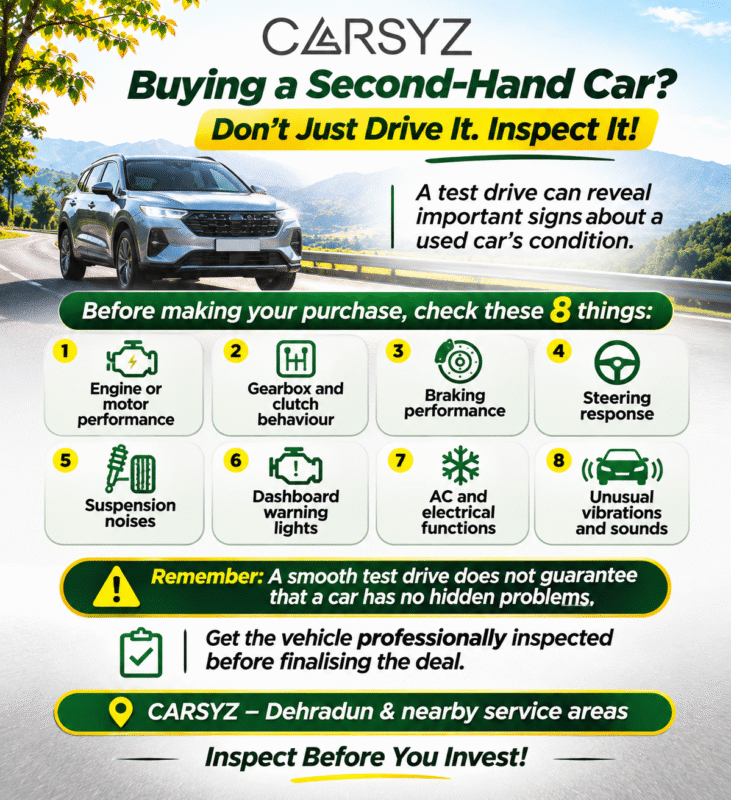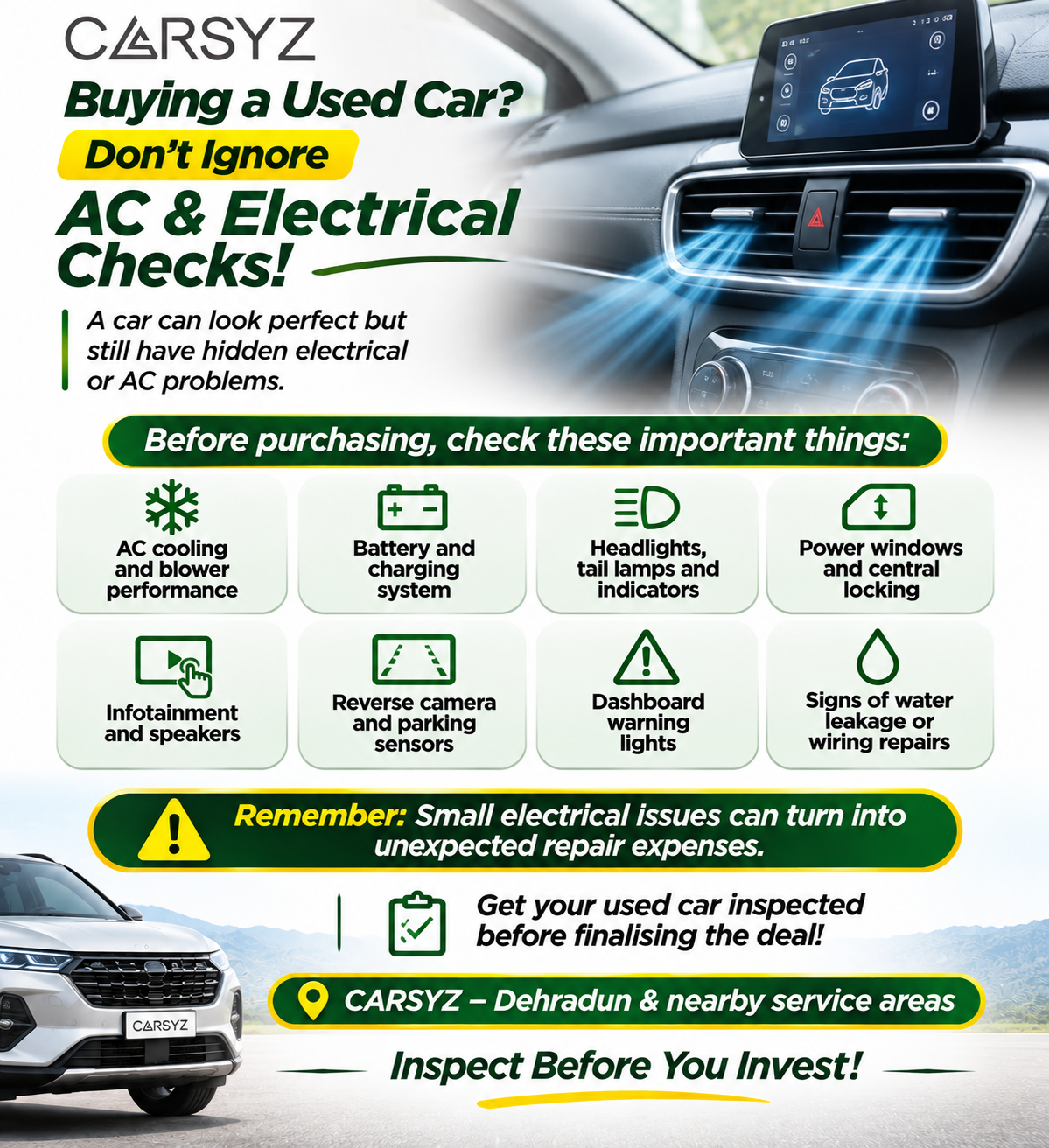
Buying a second-hand car requires more than checking its exterior, engine and tyres. The air-conditioning and electrical systems are equally important because they affect everyday comfort, convenience and vehicle functionality.
Imagine purchasing a used car and discovering that its AC does not cool properly, power windows are not working, the infotainment system keeps restarting or warning lights appear on the dashboard.
These issues can lead to unexpected repair expenses after purchase.
If you are planning to buy a used car in Dehradun or nearby areas of Uttarakhand, this guide explains how to inspect the AC and electrical systems before finalising your purchase.
1. Check the Air Conditioning Cooling Performance
The first step is to check whether the AC cools the cabin properly.
Start the car, switch on the AC and allow it to operate for a few minutes under suitable conditions.
Observe:
- Whether the AC starts normally.
- Whether cool air comes from the vents.
- Whether cooling improves as the system operates.
- Whether cooling remains reasonably consistent.
- Whether unusual sounds occur when the AC is switched on.
- Whether the system produces an unusual smell.
Cooling performance can depend on outside temperature, humidity, cabin temperature, engine operation and the condition of the AC system.
If cooling is weak or inconsistent, the vehicle may require further diagnosis.
2. Inspect the AC Blower and Fan Speeds
The blower distributes conditioned air throughout the cabin.
Test the available fan-speed settings.
Check:
- Whether the blower works at every available speed.
- Whether airflow is consistent.
- Whether there is unusual noise.
- Whether airflow changes when different modes are selected.
- Whether air comes from the correct vents.
If the blower works only at certain speeds or makes unusual sounds, have it checked before purchasing the vehicle.
3. Check Different AC Airflow Modes
Most cars offer different airflow settings.
Depending on the model, these may include:
- Face vents.
- Face and footwell vents.
- Footwell vents.
- Windscreen defogger or demister.
- Rear AC vents, where equipped.
Switch between the available modes and observe whether the airflow changes as expected.
Also check whether the temperature-control settings respond properly.
4. Check the Compressor and AC-Related Sounds
In vehicles with conventional compressor-based AC systems, listen for unusual sounds when the AC is switched on.
Pay attention to:
- Repeated clicking or rattling.
- Unusual belt noise.
- Excessive vibration.
- Changes in engine behaviour.
- Cooling that starts and stops unexpectedly.
Some systems naturally make operating sounds, and compressor behaviour varies between vehicles.
Do not assume that every sound indicates a failure. If anything seems abnormal, arrange a professional AC diagnosis.
Electric vehicles and hybrid vehicles may use different electrically driven AC compressor systems, so their inspection should follow the manufacturer’s specifications.
5. Look for Signs of AC Water Leakage
Water dripping underneath a car after AC operation can be normal condensation.
However, unexplained moisture inside the cabin or persistent dampness may require investigation.
Check:
- Front passenger footwell.
- Driver-side floor area.
- Carpet edges.
- Areas around accessible AC drain outlets.
- Unusual damp smells.
A blocked drain, water ingress or other issue may cause moisture inside the vehicle.
Do not confuse normal AC condensation outside the car with a coolant or other fluid leak.
6. Check the Car Battery and Charging System
The battery supplies electrical power for starting and many vehicle functions.
For petrol and diesel cars, inspect the battery for:
- Physical damage or swelling.
- Corrosion around terminals.
- Loose connections.
- Battery age and available warranty details.
- Starting difficulty.
- Battery warning indicators.
A battery’s condition should be assessed using a suitable battery-testing method rather than appearance alone.
Also check the charging system. An alternator or related charging-system fault can cause repeated battery problems.
For hybrid and electric vehicles, the low-voltage battery and high-voltage traction battery are different systems. Their inspection requirements also differ.
High-voltage components must only be assessed by trained technicians.
7. Test Power Windows and Central Locking
Power windows and central locking are commonly used features that should be tested before purchase.
Check:
- Every power window switch.
- Whether windows move smoothly.
- Whether any window gets stuck.
- Whether the auto-up or auto-down function works, if equipped.
- Whether central locking operates from the key or remote.
- Whether all doors lock and unlock correctly.
- Whether the child safety lock works, where applicable.
A single malfunctioning window or door lock may indicate a switch, motor, wiring or control-system issue.
8. Inspect Headlights, Tail Lamps and Indicators
Lighting systems are important for visibility and road safety.
Test:
- Low-beam headlights.
- High-beam headlights.
- Daytime running lights, if equipped.
- Front and rear indicators.
- Hazard warning lights.
- Brake lamps.
- Reverse lamps.
- Number plate illumination.
- Fog lamps, if equipped.
Check the lenses for cracks, moisture and physical damage.
Also observe whether any dashboard lighting warnings appear.
9. Check the Infotainment System and Speakers
Modern cars often have touchscreen infotainment systems with connected features.
Before buying, test:
- Touchscreen responsiveness.
- Audio output.
- All available speakers.
- Bluetooth connectivity.
- USB ports.
- Apple CarPlay or Android Auto, if equipped.
- Navigation, if available.
- Steering-mounted audio controls.
- Reverse camera display, if equipped.
Check for random restarts, blank screens, unresponsive touch controls or distorted audio.
Ask whether any software updates or repairs are pending.
10. Test Sensors, Cameras and Driver Assistance Features
Depending on the vehicle variant, test the available electronic assistance systems.
These may include:
- Rear parking sensors.
- Front parking sensors.
- Reverse camera.
- 360-degree camera.
- Blind-spot monitoring.
- Lane departure warning.
- Adaptive cruise control.
- Tyre pressure monitoring system.
The presence and functionality of these features vary by model and variant.
Check the owner’s manual for the normal operation and limitations of each feature. Do not test driver-assistance systems in a way that creates risk on public roads.
11. Inspect Dashboard Warning Lights
The dashboard should be checked before and during the test drive.
Observe the normal warning-light self-check when the vehicle is switched on.
After startup, check whether any warning indicators remain illuminated unexpectedly.
Pay attention to:
- Battery or charging-system warning.
- ABS warning.
- Airbag warning.
- Check-engine warning.
- Power steering warning.
- TPMS warning.
- Transmission warning.
- Other electrical or system warnings.
A warning light may indicate a stored or active fault that needs diagnosis.
A diagnostic scan can provide useful information, but results depend on the vehicle and scanner compatibility. A scan alone cannot guarantee that all electrical issues have been identified.
12. Look for Signs of Previous Electrical Repairs
Previous electrical repairs are not automatically a reason to reject a vehicle, but poor-quality repairs can create future problems.
Look for visible signs such as:
- Damaged insulation on accessible wiring.
- Loose or poorly secured connectors.
- Non-standard electrical accessories.
- Improperly fitted aftermarket wiring.
- Visible corrosion near connectors.
- Unusual fuse modifications.
- Evidence of water ingress.
Do not pull apart wiring harnesses or disturb electrical connectors during a basic inspection. A qualified technician should investigate suspected problems.
13. Check Wipers, Washers and Other Electrical Features
Small electrical features are easy to overlook during a used-car purchase.
Test:
- Front wipers at available speeds.
- Rear wiper, if equipped.
- Windscreen washer.
- Rear defogger.
- Horn.
- Interior cabin lights.
- Boot light.
- Glovebox light.
- Electrically adjustable mirrors.
- Seat adjustment controls, if equipped.
- Sunroof operation, if equipped.
Check these features according to the vehicle’s specifications.
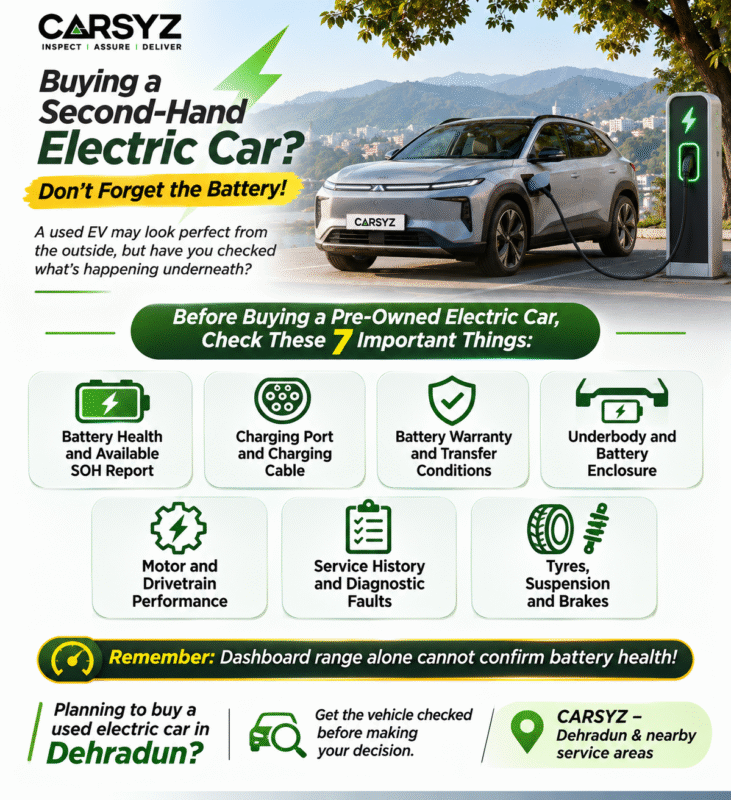
14. Special Checks for Electric and Hybrid Cars
Electric and hybrid vehicles have additional electrical systems that need suitable inspection.
Depending on the vehicle, consider checking:
- Charging port and charging cable.
- Charging operation.
- Battery-related warning indicators.
- Available battery health information.
- Motor and inverter-related fault information.
- Cooling-system warnings, where applicable.
- Low-voltage battery condition.
- Manufacturer service and recall history.
Battery State of Health (SOH) information is not available in the same format on every vehicle. A generic diagnostic scanner may not provide reliable battery-health information.
Do not touch high-voltage cables, battery terminals or internal electrical components. These systems require trained technicians and appropriate safety procedures.
15. Why a Professional Electrical and AC Inspection Matters
Some electrical problems appear only occasionally or under particular operating conditions.
A systematic inspection can help identify visible defects, non-functioning features and symptoms that need further diagnosis.
Depending on the vehicle and agreed inspection scope, checks may include:
- AC cooling and blower operation.
- Electrical switches and controls.
- Battery condition.
- Lights and indicators.
- Infotainment and cameras.
- Warning indicators.
- Available diagnostic fault information.
- Visible signs of previous repairs.
Not every issue can be detected during a basic inspection. Some problems require specialist equipment or a detailed workshop diagnosis.
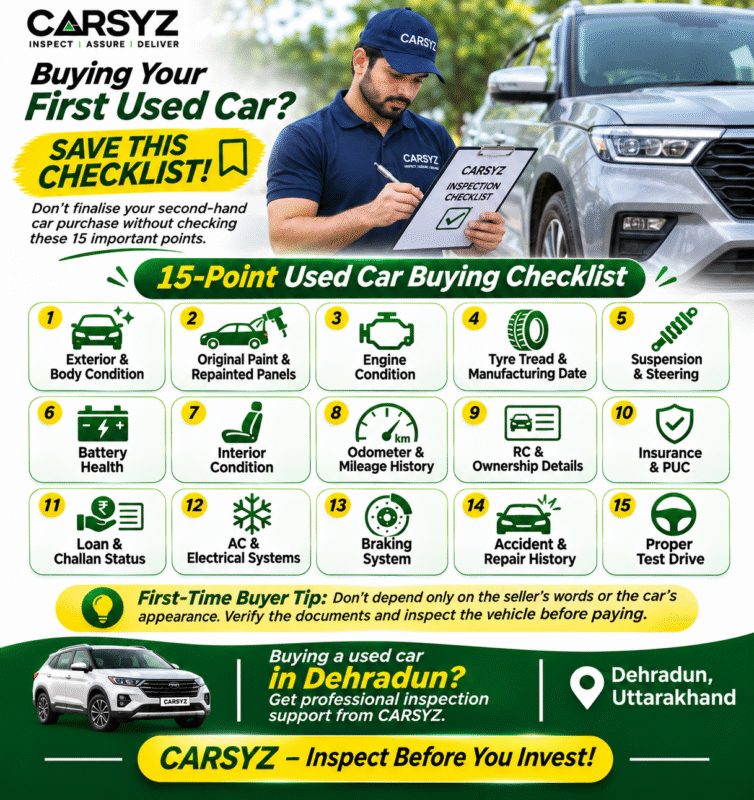
Used Car AC and Electrical Inspection Checklist
Before purchasing a second-hand car, use this quick checklist:
- AC cooling performance.
- Blower operation at different speeds.
- Airflow mode selection.
- Unusual AC noises.
- Cabin moisture or unusual smell.
- Battery condition and starting performance.
- Power windows.
- Central locking.
- Headlights and indicators.
- Brake and reverse lights.
- Infotainment and speakers.
- Parking sensors and camera.
- Dashboard warning indicators.
- Wipers, washers and horn.
- Visible signs of electrical repair or water ingress.
Used Car Inspection in Dehradun – CARSYZ
Buying a second-hand car is easier when you understand its condition before making the final payment.
CARSYZ offers used-car inspection services in Dehradun and nearby service areas to help buyers assess important vehicle areas before purchase.
Depending on the agreed inspection scope and vehicle, checks may cover exterior, interior, visible mechanical components, tyres, electrical features and other relevant areas.
Contact CARSYZ to discuss your vehicle and confirm the inspection coverage available.
CARSYZ – Inspect Before You Invest!
Frequently Asked Questions
1. How do I check AC cooling in a used car?
Switch on the AC, allow it to operate for a few minutes and check the airflow, cooling consistency, fan speeds and unusual sounds. If cooling seems weak, arrange a professional AC diagnosis.
2. How can I identify electrical problems in a second-hand car?
Test the lights, windows, central locking, infotainment system, sensors, dashboard indicators and other electrical features. Look for visible signs of poor repairs or water damage.
3. Is a battery warning light serious?
A battery or charging-system warning should not be ignored. It may indicate a charging-system or electrical fault. Have the vehicle checked before purchase.
4. Should I check the AC during a test drive?
Yes. Test the AC in suitable conditions and check cooling, airflow, fan speeds and unusual noises.
5. Can a diagnostic scanner identify all electrical problems?
No. Scanner coverage depends on the vehicle, system compatibility and diagnostic equipment. Some intermittent or physical wiring issues may require additional inspection.
6. What electrical components should I check before buying a used car?
Check the battery, lights, windows, central locking, infotainment, cameras, parking sensors, wipers, washers and dashboard warning indicators.
7. Where can I get a used car inspected in Dehradun?
You can contact CARSYZ to enquire about used-car inspection services in Dehradun and nearby areas. Confirm the inspection scope and appointment availability before booking.
Conclusion
AC and electrical systems are essential parts of a modern car. A vehicle may look clean and drive smoothly but still have hidden problems with cooling, wiring, electronics or electrical accessories.
Before purchasing a second-hand car, test the important features, observe warning indicators and investigate anything that does not work as expected.
Do not overlook small electrical issues simply because the vehicle looks good from the outside.
Planning to buy a used car in Dehradun? Get it inspected before making your decision.
CARSYZ – Inspect Before You Invest!