

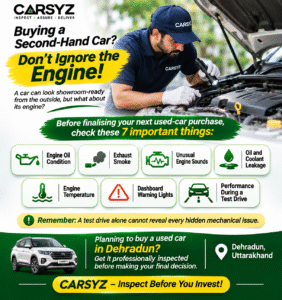
Buying a second-hand car can be a smart financial decision, but checking the engine condition is one of the most important steps before making a purchase.
A car may look attractive from the outside, have a clean interior and even come with an attractive price. However, hidden engine problems can lead to expensive repairs after the purchase.
Whether you are buying a used car in Dehradun, Haridwar, Rishikesh or anywhere else in Uttarakhand, understanding a few basic engine inspection points can help you make a more informed decision.
In this guide, CARSYZ explains how to check a used car engine, identify common warning signs and understand why a professional inspection is important before finalising a deal.
1. Check the Engine Before Starting the Car
If possible, inspect the engine when it is completely cold.
A seller may warm up the engine before your arrival, which can make certain starting problems less noticeable.
Before starting the car, check:
- Whether the engine bay looks excessively oily or dirty.
- Whether there are visible signs of fluid leakage.
- Whether any wires, hoses or connectors appear damaged.
- Whether the battery terminals show excessive corrosion.
- Whether there are unusual modifications or poorly fitted components.
A clean engine bay is not automatically a sign of a healthy engine. Some sellers clean the engine compartment before showing the vehicle, so look for other signs as well.
2. Check Engine Oil Condition and Level
Engine oil plays an important role in lubrication and reducing friction between moving components.
Check the engine oil using the dipstick, if the vehicle has one, and follow the manufacturer’s recommended checking procedure.
Look for:
- Oil level below the recommended range.
- Oil that appears unusually thick or contaminated.
- Sludge-like deposits around accessible engine components.
- Signs of oil leakage around the engine.
- A burnt smell from the oil.
Dark engine oil alone does not prove that the engine is damaged. Oil colour varies depending on the engine, oil type and usage.
Also, some modern vehicles use electronic oil-level monitoring instead of a conventional dipstick.
3. Observe Smoke From the Exhaust
Exhaust smoke can provide useful clues about engine condition, although it should never be treated as a final diagnosis on its own.
Common observations include:
Blue smoke: May indicate that engine oil is entering the combustion chamber and being burned.
Persistent white smoke: May indicate coolant entering the combustion chamber or another engine-related issue. A small amount of white vapour during a cold start can be normal condensation, especially in colder weather.
Black smoke: May indicate excessive fuel consumption or an air-fuel mixture problem, particularly in some diesel engines.
If you notice continuous or unusual smoke, get the vehicle checked by a qualified mechanic before buying it.
4. Listen for Unusual Engine Sounds
Start the engine and listen carefully.
A healthy engine generally runs smoothly, although normal operating sounds differ between petrol, diesel and other engine types.
Pay attention to:
- Repeated knocking sounds.
- Metallic rattling noises.
- Excessive vibration.
- Irregular idling.
- Unusual squealing or grinding sounds.
Some sounds may come from accessories, belts or other components rather than the engine itself. Therefore, a qualified technician should identify the actual source.
Do not ignore unusual noises simply because the car appears to drive normally.
5. Check for Oil and Coolant Leakage
Leaks can indicate maintenance issues and, in some cases, more serious mechanical problems.
Inspect the accessible areas around:
- Engine oil sump.
- Valve cover area.
- Coolant hoses and connections.
- Radiator and coolant reservoir.
- Engine seals and gaskets.
Look underneath the vehicle for fresh fluid stains.
Remember that different fluids have different colours and characteristics. Do not touch hot engine components or open a hot radiator cap.
A small leak may still require repair, so understand its source and estimated repair cost before negotiating the vehicle price.
6. Check Engine Temperature and Cooling System
The cooling system helps maintain the engine’s operating temperature.
During a safe test drive, observe the temperature gauge or warning indicators.
Warning signs include:
- Engine temperature rising unusually high.
- Temperature warning lights.
- Coolant warning messages.
- Visible coolant leakage.
- Repeated overheating history reported by the seller.
Never ignore overheating symptoms. Driving an overheating vehicle can cause significant engine damage.
7. Observe Engine Performance During a Test Drive
A test drive can reveal problems that may not be noticeable when the car is stationary.
During the drive, pay attention to:
- Delayed acceleration.
- Unusual loss of power.
- Engine hesitation.
- Excessive vibration.
- Warning lights appearing on the dashboard.
- Unusual sounds under acceleration.
Test the vehicle in safe conditions and follow traffic rules.
Engine performance also depends on the transmission, fuel system, sensors and other components. A poor driving experience does not automatically mean the engine is faulty.
8. Check Dashboard Warning Lights
Before starting the vehicle, observe the dashboard warning lights.
Many warning lights illuminate briefly when the ignition is switched on as part of the normal self-check process.
After starting the engine, check whether warning lights that should switch off remain illuminated.
Pay special attention to:
- Check Engine light.
- Engine temperature warning.
- Oil pressure warning.
- Battery/charging warning.
A diagnostic scan may help identify stored fault codes, but a scan alone cannot guarantee that a vehicle is free from mechanical problems. The scanner’s compatibility and the inspection scope also matter.
9. Ask About Engine Service History
A vehicle’s service history can help you understand how it has been maintained.
Ask the seller for:
- Previous service invoices.
- Regular oil change records.
- Major repair details.
- Cooling system maintenance records.
- Engine-related repair history.
- Available authorised service centre records.
Compare the service records with the vehicle’s age and odometer reading.
Missing records do not automatically prove that a car has been poorly maintained, but they make verification more difficult.
10. Why Professional Engine Inspection Matters
Checking an engine visually and taking a test drive can help identify obvious warning signs, but some problems are difficult to detect without technical knowledge and suitable equipment.
A professional pre-purchase inspection can help assess accessible engine components, visible leaks, warning indicators and other relevant vehicle systems within the inspection scope.
Depending on the vehicle and inspection requirements, a qualified technician may recommend additional diagnostic tests.
At CARSYZ, our goal is to help buyers make informed used-car purchase decisions through vehicle inspection support.
If you are planning to buy a second-hand car in Dehradun, consider arranging an inspection before finalising the deal.
Frequently Asked Questions
1. How can I check whether a second-hand car engine is in good condition?
Start by checking visible leaks, engine oil level, exhaust smoke, unusual sounds, dashboard warning lights and performance during a test drive. A professional inspection is recommended for a more reliable assessment.
2. Is black engine oil a sign of engine damage?
Not necessarily. Engine oil naturally becomes darker with use. Its condition should be assessed along with the oil level, service history and other engine symptoms.
3. What does blue smoke from a car exhaust mean?
Blue smoke may indicate that engine oil is being burned inside the engine. It should be inspected by a qualified mechanic.
4. Can a car with high kilometres have a good engine?
Yes. A high-mileage car can still have a well-maintained engine. Service history, driving conditions, maintenance quality and actual mechanical condition are more important than kilometres alone.
5. Is a test drive enough to check engine condition?
No. A test drive can reveal certain performance problems, but it cannot identify every hidden mechanical issue. A detailed inspection provides additional information.
6. Should I get a used car inspected before buying it in Dehradun?
Yes. A professional pre-purchase inspection can help identify visible defects and potential concerns before you make a purchase decision.
Final Thoughts
The engine is one of the most important components of any car. A vehicle that looks perfect from the outside may still have mechanical issues that are not immediately visible.
Before buying a second-hand car, check the engine oil, exhaust smoke, unusual sounds, leaks, temperature, dashboard indicators and service history. Most importantly, do not make your final decision based only on appearance or the seller’s assurances.
CARSYZ – Inspect Before You Invest!
Planning to buy a used car in Dehradun or nearby areas? Contact CARSYZ to enquire about a professional vehicle inspection and make a more informed buying decision.
